
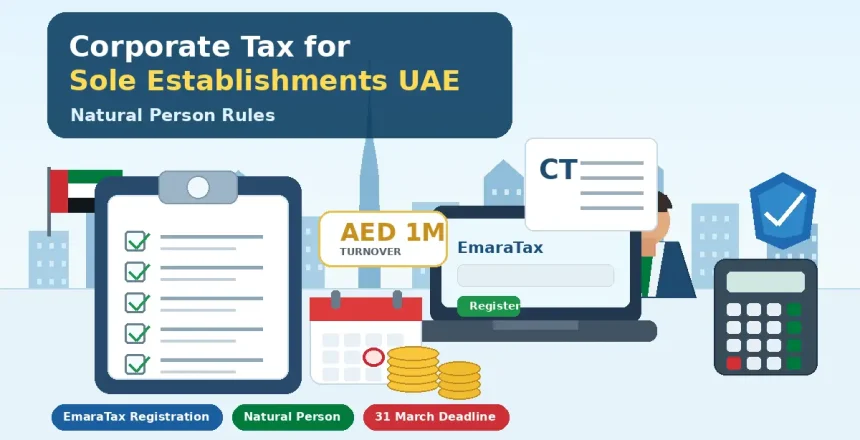
Corporate Tax for Sole Establishments UAE is an important topic for freelancers, consultants, sole establishment owners, and individual business owners in the UAE. Many people assume UAE Corporate Tax applies only to companies such as LLCs or Free Zone entities, but that is not always correct.
Federal Tax Authority (FTA) states that a natural person is subject to UAE Corporate Tax only if they conduct a Business or Business Activity in the UAE and their total turnover from those activities exceeds AED 1 million within a calendar year. Salary, Personal/Private Investment income, and Real Estate Investment income are excluded from the turnover calculation if they meet FTA conditions.
At-a-Glance Summary
- Applies to sole establishment owners, freelancers, consultants, individual partners, and natural persons conducting business in the UAE.
- A natural person may need Corporate Tax registration if annual business turnover exceeds AED 1 million.
- Turnover means gross business income before deducting costs, not profit.
- Registration is completed through EmaraTax.
- Missing the registration deadline may trigger an AED 10,000 administrative penalty.
- Once registered, the person must maintain proper accounting records and file Corporate Tax returns if required.
What Is a Sole Establishment in UAE?
A sole establishment is a business owned by one individual. Unlike an LLC or other incorporated company, the owner and the sole establishment are closely connected. The owner usually has direct control over the business and may also carry responsibility for its obligations.
A sole establishment may look similar to a freelance permit or consultant licence, but the exact treatment depends on the activity, licence, and facts. For Corporate Tax purposes, the key question is:
Is the individual conducting a Business or Business Activity in the UAE?
If yes, the next question is whether the person’s annual business turnover exceeds AED 1 million.
What Does “Natural Person” Mean for UAE Corporate Tax?
A natural person means a living individual. This is different from a juridical person, such as an LLC, company, foundation, or other legal entity.
For Natural Person Corporate Tax UAE, the FTA focuses on whether the individual conducts a business or business activity in the UAE. This may include sole establishments, freelancers, consultants, and individual partners in some unincorporated partnerships.
Not every type of income earned by an individual is business income. For example:
Real Estate Investment income may be outside Corporate Tax if it is not conducted through, and does not require, a business licence.
When Does Corporate Tax Apply to Sole Establishments?
Salary from employment is different from business income.
Personal investment income may be outside Corporate Tax if it meets FTA conditions.
A natural person is required to register for UAE Corporate Tax if total revenue from conducting business or business activities exceeds AED 1 million within a calendar year. The FTA service card confirms that salary, private investment income, and real estate investment income are excluded from this calculation.
Turnover vs profit
This is a common mistake. For natural persons, the AED 1 million test is based on turnover, not profit.
For example, if a consultant earns AED 1.2 million in fees and has AED 400,000 in business expenses, the turnover is still AED 1.2 million. The person may therefore need to register, even though net profit is lower.
Registration deadline
The FTA announced that if a natural person conducts business in the UAE and turnover exceeds AED 1 million in a calendar year, they must register for Corporate Tax by 31 March of the following calendar year. If they miss the applicable deadline, an AED 10,000 penalty may apply.
Does Registration Mean You Will Pay Corporate Tax?
Not always.
Registration means the natural person is within the Corporate Tax system. It does not automatically mean tax will be payable.
The UAE standard Corporate Tax rate structure is:
| Taxable Income | Corporate Tax Rate |
| Up to AED 375,000 | 0% |
| Above AED 375,000 | 9% on the excess |
The Ministry of Finance confirms that 0% applies to taxable income up to AED 375,000 and 9% applies to taxable income above AED 375,000.
The AED 1 million threshold is for natural person registration scope. The AED 375,000 threshold relates to the tax rate on taxable income.
What About Small Business Relief?
Small Business Relief may help some sole establishment owners, but it does not remove the registration obligation once the AED 1 million business turnover threshold is exceeded.
The FTA states that eligible resident persons may elect Small Business Relief where revenue is AED 3 million or less in the current and previous tax periods, subject to conditions. If elected, the person is treated as not having derived taxable income for that tax period.
This relief is not automatic. Sole establishment owners should review eligibility before filing.
Corporate Tax Registration for Sole Establishments
Corporate Tax registration is completed through EmaraTax. The FTA service card confirms that the service is free of charge, available 24/7, has an estimated submission time of 25 minutes, and the FTA’s estimated completion time is 20 business days from receiving a completed application.
Information usually required may include:
- passport and Emirates ID, if applicable;
- contact details;
- sole establishment or licence details;
- VAT or Excise Tax details, if any;
- bank account details, where required.
VAT registration does not replace Corporate Tax registration. If a natural person falls within Corporate Tax scope, a separate Corporate Tax registration may still be required.
What Income Is Taxable and What May Not Be?
| Income Type | Usually Taxable? | Notes |
| Consultancy income | Yes, if turnover exceeds AED 1 million | Common business activity |
| Professional service income | Yes, if turnover exceeds AED 1 million | Includes IT, marketing, advisory, design |
| Trading income | Yes, if turnover exceeds AED 1 million | Usually business income |
| Freelance income | Yes, if turnover exceeds AED 1 million | Relevant for licensed freelancers |
| Salary income | Usually no | Wages are excluded |
| Personal investment income | Usually no | Must meet FTA conditions |
| Real estate investment income | Case-specific | Review if licensed or business-related |
If income is connected to a business account or business activity, it should be reviewed carefully.
Key Compliance Responsibilities
If your sole establishment falls within Corporate Tax, you should maintain:
- bookkeeping records;
- invoices and receipts;
- business expense records;
- bank statements;
- VAT records, if VAT-registered;
- Corporate Tax registration details;
- Corporate Tax return working papers.
The Ministry of Finance explains that Corporate Tax is calculated on taxable income, generally starting from accounting income and applying required adjustments.
Common Mistakes to Avoid
Sole establishment owners should avoid:
- assuming Corporate Tax applies only to companies;
- confusing turnover with profit;
- mixing personal and business bank transactions;
- ignoring EmaraTax registration;
- assuming VAT registration covers Corporate Tax;
- not tracking annual revenue;
- waiting until the deadline;
- assuming Small Business Relief applies automatically.
How CorporateTaxRegistration.ae Can Help
Corporate Tax registration;
- EmaraTax registration support;
- AED 1 million turnover review;
- bookkeeping cleanup;
- Corporate Tax return preparation;
- VAT coordination;
- Small Business Relief review;
- penalty risk reduction.
If you are unsure whether your sole establishment must register, a professional review can help you avoid missed deadlines and unnecessary penalties.