
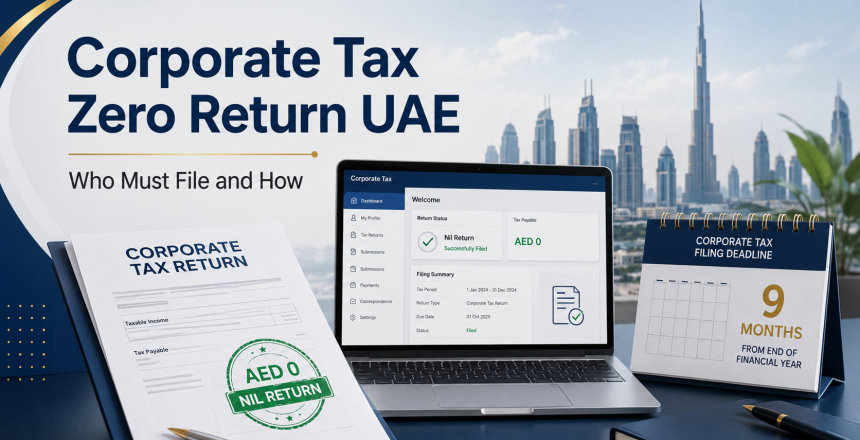
Corporate Tax Zero Return UAE is an important topic for UAE businesses with no profit, no revenue, tax losses, or AED 0 Corporate Tax payable. Many business owners assume that if no tax is due, no return is required. That assumption can create compliance risk.
As of June 2026, the Federal Tax Authority (FTA) has confirmed that all Corporate Taxable Persons, regardless of income level, have a legal obligation to file Corporate Tax Returns. Exempt Persons required to register must submit annual declarations within the relevant deadline.
What Is a Corporate Tax Zero Return in UAE?
A Corporate Tax zero return is not a separate exemption category. It is a practical term used when a registered business files a Corporate Tax return and the final Corporate Tax payable is AED 0.
This may happen when:
- the business has no revenue;
- the business made a tax loss;
- taxable income is below the taxable threshold;
- tax losses or adjustments reduce taxable income;
- Small Business Relief is elected correctly;
- a Free Zone Person has qualifying income taxed at 0%.
Corporate Tax is imposed on Taxable Income, and the starting point is generally accounting income, adjusted for UAE Corporate Tax rules.
Zero Return vs No Filing: What Is the Difference?
This is the most important point.
A zero return means you file the return and report AED 0 Corporate Tax payable.
No filing means no return is submitted at all.
For registered Corporate Taxable Persons, no filing can create penalties even where the tax payable is zero. The FTA has stated that Corporate Taxable Persons must file returns within the prescribed deadline, regardless of income level.
Who Must File a Corporate Tax Zero Return?
1. Registered UAE businesses with AED 0 tax payable
If your company is registered for Corporate Tax and has no tax payable, you should still review whether a return must be submitted. This can include mainland companies, Free Zone companies, startups, loss-making businesses, and businesses with no activity.
2. Dormant or inactive companies
A dormant or inactive company should not assume there is no filing obligation. The company should review its licence status, Corporate Tax registration status, and whether it remains a Taxable Person before deciding that no return is required.
3. Free Zone companies
Free Zone companies are still within the UAE Corporate Tax regime. A Qualifying Free Zone Person may benefit from a 0% rate on qualifying income, but this does not automatically remove Corporate Tax compliance obligations. MoF guidance states that all Taxable Persons, including Free Zone Persons, are required to register and file within the relevant deadline.
4. Businesses using Small Business Relief
Small Business Relief may apply to eligible Resident Persons where revenue is AED 3 million or less in the current and all previous Tax Periods, subject to conditions. If elected, the person is treated as not having derived taxable income for that period. However, the relief is not automatic and must be handled correctly in the Corporate Tax process.
Corporate Tax Zero Return Deadline in UAE
The standard Corporate Tax return filing deadline is within 9 months from the end of the relevant Tax Period. The same deadline generally applies for payment of any Corporate Tax due.
Even if Corporate Tax payable is AED 0, the return should still be filed on time where the business has a filing obligation.
How to File a Corporate Tax Zero Return on EmaraTax
Corporate Tax returns are filed through the EmaraTax platform. The FTA states that EmaraTax is available 24/7 for Corporate Tax registration, return filing, settlement of Corporate Tax payable, and other tax procedures.
Basic steps:
- Log in to EmaraTax.
- Select the relevant Taxable Person.
- Open the Corporate Tax return for the correct Tax Period.
- Review business details, TRN, financial year, and accounting information.
- Enter income, expenses, tax adjustments, losses, reliefs, and credits.
- Confirm that Corporate Tax payable is AED 0, if supported by records.
- Submit before the deadline.
- Save the acknowledgement and return copy.
The FTA notes that return information includes details such as the Tax Period, TRN, accounting principles, taxable income, Tax Loss Relief, tax losses carried forward, tax credits, and Corporate Tax payable.
Documents to Prepare Before Filing
Prepare the following before filing a zero or nil Corporate Tax return:
- financial statements or management accounts;
- trial balance;
- bank statements;
- invoices and receipts;
- revenue and expense schedules;
- VAT returns, if VAT registered;
- tax loss schedules, if applicable;
- Small Business Relief assessment, if relevant;
- Free Zone qualifying income review, if applicable.
Good records reduce errors and help support the AED 0 tax payable position if the FTA asks for clarification.
Penalties for Late Filing or Late Payment
Late submission of a Corporate Tax return can result in an administrative penalty of AED 500 for each month or part of a month for the first 12 months, increasing to AED 1,000 for each month or part of a month from the 13th month onwards.
Late payment of Corporate Tax payable is separate. The official penalty schedule states that failure to settle Payable Tax may result in a monthly penalty calculated at 14% per annum on the unsettled Payable Tax amount.
For a true zero return where Corporate Tax payable is AED 0, late payment may not be relevant, but late filing penalties can still apply if the return is submitted after the deadline.
Also remember: late Corporate Tax registration is a separate issue. The Ministry of Finance confirmed an AED 10,000 penalty for late Corporate Tax registration where the application is not submitted within the FTA timelines.
Common Mistakes to Avoid
Avoid these mistakes:
- assuming AED 0 tax means no return;
- confusing nil return with no filing;
- ignoring Free Zone filing requirements;
- assuming Small Business Relief applies automatically;
- filing without proper accounting records;
- mixing VAT and Corporate Tax obligations;
- waiting until the last week before the deadline;
- not saving EmaraTax proof of submission.
How CorporateTaxRegistration.ae Can Help
At CorporateTaxRegistration.ae, we help UAE businesses with:
- Corporate Tax registration;
- Corporate Tax zero return filing;
- EmaraTax return submission;
- Small Business Relief review;
- Free Zone Corporate Tax review;
- accounting records review;
- tax return preparation;
- penalty risk reduction.
If your business has AED 0 tax payable, it is still worth checking your filing position before the deadline.