
UAE Small Business Relief 2029: AED 3 Million Eligibility and Filing Rules
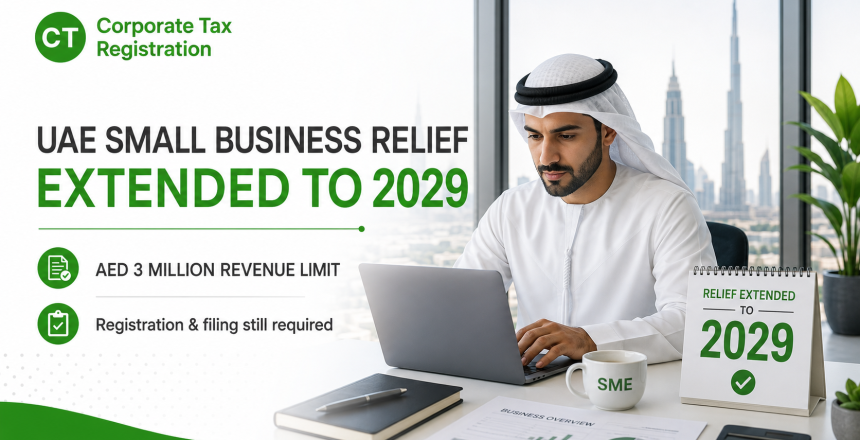
Under Ministerial Decision No. 131 of 2026, UAE Corporate Tax Small Business Relief (SBR) now covers eligible Tax Periods beginning on or after 1 June 2023 and ending on or before 31 December 2029. This replaces the former 2026 end date.
The AED 3 million Revenue threshold is unchanged, and relief is not automatic. Eligible businesses must register for Corporate Tax, file on time and elect SBR for each relevant Tax Period.
For a 31 December 2025 year-end, the return must be filed—and any Corporate Tax due paid—by 30 September 2026. The extension does not postpone this filing deadline.
What does Small Business Relief do?
Under Article 21 of the UAE Corporate Tax Law, an eligible Resident Taxable Person electing SBR is treated as having no Taxable Income for that period. This generally means:
- no Corporate Tax is payable for that period;
- a simplified Corporate Tax return can be filed; and
- several calculations under the normal Corporate Tax rules do not apply.
Registration, filing and record-keeping still apply. SBR also differs from the normal 0% rate on Taxable Income up to AED 375,000: SBR tests Revenue, not Taxable Income.
Who is eligible for UAE Small Business Relief?
Before electing SBR, confirm that:
- The claimant is a Taxable Person that is a Resident Person for UAE Corporate Tax purposes.
- Revenue is no more than AED 3 million in the current or any previous Corporate Tax Period beginning on or after 1 June 2023.
- The claimant is not a Qualifying Free Zone Person for that period.
- The claimant is not a Constituent Company of an MNE Group, as defined in Cabinet Resolution No. 44 of 2020, whose consolidated Revenue meets the applicable AED 3.15 billion threshold.
- The election is made in the Corporate Tax return for that period.
Once Revenue exceeds AED 3 million in a covered Tax Period, SBR cannot be reclaimed in a later covered period.
A Resident Natural Person may qualify after aggregate UAE Business Turnover exceeds AED 1 million in a Gregorian year. Wages and qualifying personal investment and real estate investment income are excluded.
Revenue means gross income—not profit
Revenue is broadly gross income determined under UAE-accepted accounting standards. It may include sales, services, foreign business income, non-cash receipts, business-asset sale proceeds and otherwise exempt income such as certain UAE dividends. VAT collected for the FTA is excluded.
For example, AED 2.8 million of service income plus AED 300,000 from selling a business vehicle may produce Revenue of AED 3.1 million. Low profit would not restore eligibility.
Near the threshold, reconcile accounts, receipts, asset disposals, VAT returns and related-party transactions before electing.
Can a Free Zone company claim SBR?
A Free Zone licence does not automatically prevent SBR. A Qualifying Free Zone Person (QFZP) is excluded, while another Free Zone Person may qualify.
The FTA guide states that a QFZP electing standard Corporate Tax treatment under Article 19 for a period is then considered a Free Zone Person and may claim SBR if eligible. Model the wider consequences before making that election.
SBR still requires a Corporate Tax return
The FTA’s 3 August 2026 reminder confirms that a claimant must:
- be registered for Corporate Tax;
- file within the applicable deadline;
- elect SBR in the return for the relevant period;
- report accurate Revenue; and
- retain evidence supporting eligibility.
The FTA’s August 2023 SBR guide says SBR cannot be added after a return is submitted without the election. The guide is non-binding and predates Decision No. 131; its 2026 end-date references are superseded. Seek advice before correcting a submitted return.
Is electing SBR always better?
No. SBR removes the tax charge for that period but affects other reliefs:
| If SBR is elected | Under the normal rules |
| No Taxable Income is calculated | Taxable Income is calculated normally |
| A current-period accounting loss cannot be declared as a Tax Loss | A qualifying Tax Loss may be carried forward |
| Earlier Tax Losses remain carried forward but cannot be used in the SBR period | Brought-forward losses may be used, subject to conditions |
| Net Interest Expenditure cannot be accrued or utilised in that period | The normal interest limitation rules apply |
| Qualifying Group and Business Restructuring Relief cannot be applied | Those reliefs may be available if their conditions are met |
The arm’s-length principle still applies to related-party transactions, although certain formal transfer-pricing documentation requirements do not.
Loss-making, financed or restructuring businesses should compare SBR with the normal rules before filing.
Records and anti-abuse checks
Keep invoices, ledgers, bank and payment statements, asset-sale records, Revenue reconciliations, financial statements and the return for at least seven years after the relevant Tax Period.
Do not artificially divide a business to remain below AED 3 million. The FTA may consider financial, economic, organisational and operational links under the anti-abuse rules.
Practical filing checklist
Before submitting the return:
- Confirm the Tax Period and deadline.
- Verify Corporate Tax registration and Resident Taxable Person status.
- Reconcile Revenue for the current and every previous covered Tax Period.
- Check QFZP, Article 19, MNE and Tax Group status.
- Compare SBR with the normal tax calculation and future reliefs.
- Make the election in the return and review all Revenue disclosures.
Retain the eligibility assessment with the return working papers