
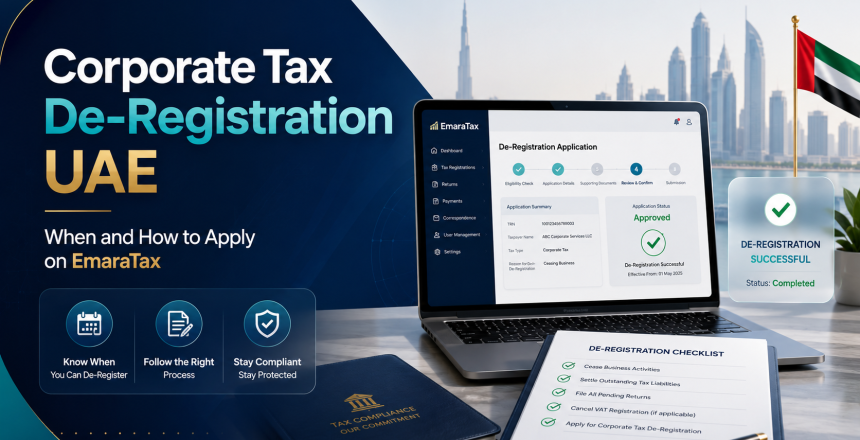
Corporate Tax De-Registration UAE, also searched as corporate tax deregistration UAE, is an important compliance step for businesses that have closed, stopped trading, merged, sold their business, redomiciled, or otherwise ceased their taxable activity in the UAE.
Many business owners assume that cancelling a trade licence automatically cancels Corporate Tax obligations. That is not always correct. Corporate Tax De-Registration is a separate process handled through the Federal Tax Authority (FTA) via EmaraTax.
As of July 2026, the FTA Corporate Tax guides page lists Corporate Tax De-Registration as an official user manual topic, with an issue date of 9 April 2026. The same FTA page was last updated on 9 July 2026, making this a current and relevant compliance topic for UAE businesses.
What Is Corporate Tax De-Registration in UAE?
Corporate Tax De-Registration is the process of formally cancelling a Corporate Tax registration with the FTA when the person no longer needs to remain registered for Corporate Tax purposes.
Under UAE Corporate Tax Law, a person with a Tax Registration Number must file a Tax Deregistration application where there is a cessation of Business or Business Activity, including dissolution, liquidation, or otherwise. The application must be filed in the form, manner, and timeline prescribed by the FTA.
In simple terms: if your business has stopped operating or no longer carries out a taxable business activity, you may need to formally close your Corporate Tax record with the FTA.
When Should a Business Apply for Corporate Tax De-Registration?
The FTA user manual states that a Corporate Tax registered taxpayer may apply for de-registration based on:
- cessation of business;
- sale of business;
- merger of business;
- redomiciliation of business;
- any other reason for Corporate Tax purposes.
This may apply to:
- companies under liquidation;
- businesses that cancelled their trade licence;
- businesses sold to another person;
- entities merged into another company;
- companies redomiciled outside the UAE;
- natural persons who ceased all business activities;
- businesses that no longer have a UAE Corporate Tax obligation.
Important: Corporate Tax De-Registration should not be used only because the business has AED 0 tax payable, no profit, or a temporary inactive period. If the business still exists and remains within Corporate Tax scope, it may need to file a zero return instead of applying for de-registration.
Corporate Tax De-Registration vs Trade Licence Cancellation
Trade licence cancellation and Corporate Tax De-Registration are separate processes.
| Item | Trade Licence Cancellation | Corporate Tax De-Registration |
|---|---|---|
| Authority | Licensing authority / Free Zone authority | Federal Tax Authority |
| Platform | Depends on licensing authority | EmaraTax |
| Purpose | Cancels business licence | Cancels Corporate Tax registration |
| Automatic link? | Not always | Separate FTA process may be required |
| Final return risk | Not applicable directly | Final Corporate Tax return may be required |
| Certificate | Licence cancellation certificate | Corporate Tax De-Registration Certificate |
Before applying for Corporate Tax deregistration, check whether the business has filed all due returns, settled outstanding tax, paid administrative penalties, and closed any related FTA obligations.
Key Conditions Before FTA Approval
The UAE Corporate Tax Law states that a Taxable Person will not be deregistered unless it has paid all Corporate Tax and administrative penalties due and filed all required Tax Returns, including the return for the period up to and including the cessation date.
This means the FTA may not approve de-registration if:
- Corporate Tax returns are pending;
- administrative penalties are unpaid;
- Corporate Tax payable is outstanding;
- a final return is required but not submitted;
- other EmaraTax applications are pending.
The FTA user manual also states that the FTA may request a final return and will not proceed with the De-Registration application if the taxpayer has other pending applications, such as a Change in Tax Period application.
How to Apply for Corporate Tax De-Registration on EmaraTax
The process is completed through EmaraTax. The FTA user manual explains that the taxpayer should log in, select the relevant taxable person, open the registered Corporate Tax application, click the three-dot menu, and select “Deregister” to start the Corporate Tax De-Registration application.
General steps:
- Log in to EmaraTax using credentials or UAE Pass.
- Select the relevant Taxable Person.
- Open the Corporate Tax application.
- Click the three-dot menu next to the registered Corporate Tax application.
- Select Deregister.
- Read the instructions and guidelines.
- Complete the De-Registration Details section.
- Enter cessation details.
- Upload supporting documents.
- Review and submit the declaration.
- Save the application reference number.
After submission, the FTA may approve, reject, or request additional information. The application status can be checked from the EmaraTax dashboard.
Documents and Information Usually Needed
Documents vary depending on the reason for de-registration. They may include:
- trade licence cancellation certificate;
- liquidation certificate or liquidator letter;
- sale agreement or transfer documents;
- merger documents;
- board resolution or owner declaration;
- final management accounts;
- final Corporate Tax return support;
- proof that business activity has ceased;
- evidence of settlement of tax liabilities or penalties.
The FTA manual states that documents submitted should support the information entered in the application to avoid rejection or resubmission. It also notes that the taxpayer cannot amend the De-Registration Details section inside the de-registration application; updates must be made using the Amend Taxable Person Details application instead.
What Happens After Submission?
Once the application is submitted, EmaraTax generates a reference number. Keep this number for future communication with the FTA.
The FTA may:
- approve the application;
- reject it;
- request additional information;
- request a final Corporate Tax return.
Once approved, the registration status becomes “Deregistered”, and a Corporate Tax De-Registration Certificate is issued in EmaraTax. The certificate can be viewed and downloaded from the Certificates section.
Penalty for Late Corporate Tax De-Registration
Failure to submit a Corporate Tax de-registration application within the specified timeframe can result in a penalty of AED 1,000 for late submission, imposed monthly on the same date, up to a maximum of AED 10,000.
The exact de-registration deadline can depend on the taxpayer’s situation and the applicable FTA guidance. Businesses should verify the latest deadline before applying or consult a UAE Corporate Tax advisor.
This penalty is separate from other Corporate Tax penalties, such as late registration, late return filing, failure to keep records, or late payment of Corporate Tax payable.
Common Mistakes That Delay De-Registration
Avoid these mistakes:
- assuming licence cancellation closes Corporate Tax automatically;
- applying for de-registration when the business is only temporarily inactive;
- not filing the final Corporate Tax return;
- leaving penalties or liabilities unpaid;
- submitting unclear supporting documents;
- using the wrong cessation date;
- applying while another EmaraTax application is pending;
- not checking VAT or Excise obligations separately;
- ignoring FTA additional information requests.
The FTA manual confirms that once an application is submitted and under review, the taxpayer cannot edit or cancel it.
How CorporateTaxRegistration Can Help
At CorporateTaxRegistration.ae, we help UAE businesses with:
- Corporate Tax De-Registration review;
- EmaraTax deregistration application support;
- final Corporate Tax return preparation;
- liquidation and business cessation compliance;
- outstanding penalty and liability review;
- document preparation;
- FTA additional information response support.
If your business has closed, stopped trading, or changed structure, a professional review can help avoid penalties, delays, and rejected applications.