
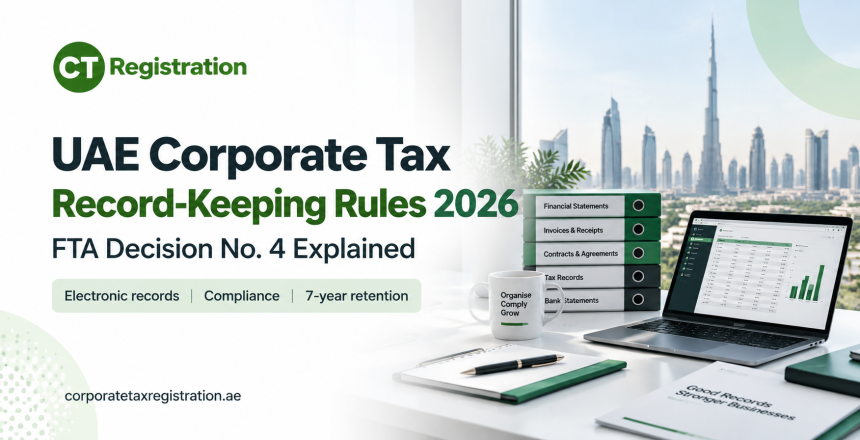
UAE businesses may keep accounting records electronically, but a digital file is not automatically compliant. FTA Decision No. 4 of 2026 explains how accounting records and commercial books must be preserved so that the Federal Tax Authority (FTA) can read, retrieve and verify them. The decision was issued on 2 June 2026, became effective on 30 July 2026, and was published on the FTA website in August.
The decision clarifies standards for complete copies, legibility, access and outsourced record-keeping. It does not introduce the existing seven-year Corporate Tax retention period.
What Is FTA Decision No. 4 of 2026?
FTA Decision No. 4 of 2026 establishes detailed rules for maintaining the information contained in accounting records and commercial books. It operates under the UAE Tax Procedures framework, so its relevance extends beyond Corporate Tax to persons subject to other applicable tax record-keeping obligations.
The decision should be read together with Cabinet Decision No. 74 of 2023, which permits information from original documents to be retained as electronic copies or photocopies when prescribed requirements are met.
The practical test: can the business produce complete, readable records enabling the FTA to verify its tax obligations? A summary spreadsheet without supporting documents may not suffice.
What Are the New Requirements for Accounting Records?
Article 2 of the 2026 decision states three core rules: records must be complete and identical to the originals, clear and easily legible, and accessible to the FTA on request, including access to the system where records are stored.
Article 3 adds specific requirements for electronic copies and photocopies:
FTA requirement | What businesses should check |
Complete copies | Every original page is included, in the same order. |
No partial scanning | Do not retain only the first page or selected sections. |
Readable information | Names, figures, dates and other details remain clear on screen. |
Durable paper copies | Copies must not fade during the applicable retention period. |
Accessible storage | The business can locate and provide records, including relevant system access, when requested. |
Black-and-white photocopies are permitted if details remain legible. Decision No. 4 specifies no minimum scanner resolution, compulsory PDF format or accounting-software brand.
Are Scanned Invoices and Electronic Documents Acceptable?
Yes, subject to the prescribed conditions. The tax procedures rules permit retention of information as an electronic copy or photocopy rather than necessarily retaining every supporting original in paper form. However, the copy must preserve all required information and remain reproducible and accessible.
Scan every page of multi-page agreements and retain readable supplier invoices with accounting entries. Before discarding originals, check separate contractual or legal requirements.
Can Businesses Use Cloud Accounting Software?
Decision No. 4 does not prohibit cloud accounting or require a particular software product. What matters is the ability to preserve and access complete records. A cloud ledger, however, is not a substitute for missing invoices, contracts or source documents.
What Access Can the FTA Request?
The FTA may request access to records and the systems storing them. Article 3 specifically provides that, where electronic copies or systems are protected by passwords or encryption, the person must make the necessary passwords or encryption keys available to enable FTA access. Access to stored photocopies must also be available, including their storage locations.
Verify requests and coordinate access through authorised FTA channels. Backups, role-based permissions and retrieval tests are recommended controls, not additional software specifications in the decision.
Who Is Responsible When Accounting Is Outsourced?
The business remains legally responsible, even when an external accountant, bookkeeping company, cloud provider or document-storage supplier maintains its records. Article 4 expressly allows engaging a third party but retains responsibility for record maintenance and safety with the person concerned.
Service agreements should define storage, export rights, FTA access and what happens when providers change. Test independent retrieval.
How Long Must Corporate Tax Records Be Kept in the UAE?
Article 56 of Federal Decree-Law No. 47 of 2022 requires Taxable Persons to retain relevant Corporate Tax records for seven years after the end of the Tax Period to which they relate. The records must support return information and enable taxable income to be determined. Exempt Persons must likewise retain records supporting their exemption status for seven years.
For example, records relating to a Tax Period ending 31 December 2026 generally need to remain available through 31 December 2033.
The seven-year rule predates Decision No. 4. Other tax-procedure periods or extensions may apply, including for audits and disputes. VAT, real-estate and other records may require separate assessments.
For return timing and the connection between records and filing, see our guide to UAE Corporate Tax return deadlines.
Which Corporate Tax Records Should a UAE Business Maintain?
Cabinet Decision No. 74 of 2023 identifies accounting records and source documents including financial statements, wages, fixed assets, inventory, invoices, contracts, licences and tax calculations. The exact file should reflect the business and its transactions.
Maintain invoices, ledgers, bank reconciliations, payroll, assets, stock, contracts and financial statements, plus relevant workings for tax adjustments, reliefs, losses and related-party transactions.
No tax payable does not mean no evidence is required. A loss-making or inactive registered company should support its reported position. See our Corporate Tax zero-return guide for filing requirements.
Practical 2026 Digital Record-Keeping Checklist
Use this as an internal management control rather than a separate FTA-prescribed application form:
- Inventory your records. Identify paper files, cloud folders, accounting systems and the relevant Tax Periods.
- Check completeness. Confirm every page of key invoices, agreements and statements is retained.
- Test readability. Open sample scans on screen and verify figures, dates and attachments.
- Connect evidence to entries. Link source documents to ledger transactions and tax workings.
- Test retrieval. Retrieve an older transaction and its evidence within a reasonable internal target.
- Control access. Set appropriate user permissions, backups and procedures for official requests.
- Review outsourced storage. Confirm export rights, responsibilities and access arrangements.
- Apply retention rules. Document the applicable Corporate Tax period and check for other legal requirements.
Common Mistakes to Avoid
Common failures include saving only a cropped invoice, relying on an unreadable scan, keeping tax totals without underlying documents, losing access after changing software, and assuming the outsourced bookkeeper carries the legal obligation. Decision No. 4 focuses on information integrity and accessibility, not merely whether files are stored online.
What Should Businesses Do Now?
Ask finance to retrieve one sale, purchase, bank transaction and year-end tax adjustment. Assign owners to missing evidence and access gaps.
Companies preparing their first tax file should also verify their UAE Corporate Tax registration and filing responsibilities. Registration, reporting and record-keeping are distinct compliance obligations.
Conclusion
FTA Decision No. 4 of 2026 makes the standard for retained accounting information more explicit: copies must be complete, legible and accessible, while outsourcing does not transfer legal responsibility. For Corporate Tax, the separate seven-year retention rule continues to apply.
A reliable digital evidence trail supports accurate returns and FTA reviews. For help, contact CorporateTaxRegistration.ae for a compliance assessment.